
When Empathy Becomes Over-Responsibility

Are you an empath who takes on too much?
Through my work with energy healing, intuitive readings and deeper soul clearings, I often meet with sensitive, empathetic people who are finding it difficult to maintain their balance. Given the current state of the world, this is hardly surprising. We are living through turbulent times, with so much change, uncertainty and suffering unfolding around us. Even when world events do not directly affect our own lives, the constant undercurrent of tension in the collective consciousness can weigh heavily on those who are particularly sensitive to the energies and emotions around them.
Yet many of the empaths I work with are already very conscious of what they allow into their lives. They have learned to be discerning about the people they spend time with, the conversations they engage in and the information they consume. They may deliberately limit their exposure to negativity, including mainstream news, to protect their peace and preserve their energy. And still, despite these choices, many find themselves emotionally overwhelmed, drained or unable to switch off from everything they sense and feel. It is one thing to step back from the news, distance ourselves from draining influences or take time alone to restore our balance. It is quite another when someone close to our heart is struggling.
These relationships touch us deeply. We care, often profoundly, and we naturally want those we love to be happy and well. For some empaths, however, caring can quietly become something more. They may not only feel a loved one’s distress, but also take on responsibility for easing their discomfort, resolving their difficulties or restoring their happiness. This is something I increasingly see in my work with clients, and it can be far more challenging to recognise and navigate than we might imagine. I feel this is particularly important to explore at this point in our collective evolution. The world needs sensitive, caring people who can remain present, compassionate and connected without becoming so depleted that they lose touch with their own lives, their gifts and their sense of purpose. The answer isn’t to become less sensitive or to close the heart. It is to understand what may lie beneath these patterns of over-giving, and discover a way of relating to others that allows everyone to remain whole.
When caring becomes carrying
There is a difference between caring about someone and feeling responsible for making everything all right for them. Healthy support means listening, offering comfort, sharing a perspective and helping where genuinely possible. It allows us to be present with someone who is struggling without needing to take away their discomfort or find an immediate solution.
But sometimes the desire to help goes further. An empath may anticipate other people’s needs before they are expressed, try to prevent disappointment, smooth over disagreements or take on more than their fair share because watching someone else struggle feels unbearable. Their thoughts may continue to revolve around another person’s difficulties long after a conversation has ended. They replay what was said, imagine possible outcomes and wonder what more they could do. And when a loved one remains unhappy, rejects advice or continues making choices that are difficult to watch, concern can gradually turn into frustration, anxiety or helplessness.
This brings us to a subtle but important aspect of over-responsibility: the need to control emotional outcomes.
Control does not necessarily mean wanting to dominate someone or dictate their life. Often, the impulse comes from a place that genuinely feels like love. The intention is to make things better, relieve suffering and restore peace or harmony. Sometimes, though, there is another layer beneath an empath’s urge to help: the discomfort of sitting with how another person’s distress makes them feel. It can stir up fear, guilt, helplessness or anxiety, along with a difficulty tolerating uncertainty. If that person can be helped to feel better, then perhaps their own worry and guilt will ease, too. Without consciously recognising it, an empath may become invested not only in supporting someone, but also in ensuring that the person feels the way they want them to feel.
This is an important distinction. Genuine emotional support can coexist with allowing another person to experience sadness, disappointment or uncertainty, make their own decisions and work through life’s difficulties. Their unhappiness does not automatically mean something has gone wrong or that someone else must fix it. Sometimes, the most loving thing we can do is simply remain present and hold space without taking over.
When the pattern becomes unhealthy
So why can stepping back feel so difficult, even when someone recognises that they are taking on too much?
The term codependency is commonly used to describe relationship patterns in which a person’s emotional wellbeing, self-worth or sense of identity becomes overly tied to another person’s needs, emotions or behaviour. Someone caught in such a dynamic may unconsciously feel the need to be needed, derive much of their sense of purpose from looking after others or feel secure in a relationship only when the other person is happy with them. They may repeatedly put themselves last, struggle to say no or feel guilty when they choose to do something for themselves. These patterns don’t always look dramatic. Sometimes, they appear as exceptional helpfulness, patience, or understanding. The empath becomes the person everyone turns to: the one who remembers what needs doing, anticipates difficulties and keeps everything running smoothly.
From the outside, they may appear capable and generous. Inside, however, they may feel exhausted, resentful or quietly long for some breathing space — and for someone to look after them in return. For some, these patterns have their roots in childhood. Perhaps they grew up needing to pay close attention to a parent’s moods. Tension at home may have made keeping the peace feel essential, while being helpful, undemanding or well-behaved made it easier to feel loved and secure.
A child who becomes skilled at reading the emotional atmosphere may develop remarkable sensitivity to others. They learn to anticipate needs, avoid conflict and adapt quickly to changing moods. These can be valuable abilities, but they may also have developed as ways of navigating circumstances that felt unpredictable or emotionally difficult. Early experiences like these can also shape beliefs about what love requires. A person may grow up equating being loving with protecting others from pain: stepping in when things go wrong, or shielding those they care about from the consequences of their choices. Yet there is an important difference between offering support and taking away someone’s opportunity to face their own experiences, make their own decisions and learn from the outcomes.
As adults, these familiar responses can continue long after the original circumstances have changed. Empaths may automatically put other people’s needs first, feel anxious when there is disagreement or fear that saying no could threaten a relationship. Some become so accustomed to attending to everyone else’s needs that they struggle to identify what they themselves want.
Of course, being an empath does not automatically mean being codependent, and caring deeply is not unhealthy in itself. The important question is whether that care also leaves room for the wellbeing of the person giving it.
Can support be offered without feeling compelled to rescue? Can a loved one be disappointed without an immediate attempt to put things right? Is it possible to love someone while accepting that their feelings, decisions and experiences ultimately belong to them? These questions are not always easy to sit with. But recognising such a dynamic can be the beginning of meaningful change. A way of relating that may once have provided emotional safety might no longer serve the person they have become.
Why it’s harder with loved ones
Over-responsibility can manifest differently depending on the relationship.
With a romantic partner, there may be repeated attempts to resolve difficulties, manage emotions or encourage the other person to make different choices. Considerable energy can go into carefully choosing words, adjusting behaviour or searching for ways to improve the relationship. When a partner is unhappy, an empath may interpret it as a reflection of themselves or the relationship, even when those feelings have little to do with them. Before long, one person can end up carrying the emotional responsibility for two.
With parents, the patterns can run particularly deep. Even in adulthood, familiar roles may resurface during family interactions. There may still be the need for approval, a fear of disappointing a parent, a sense of responsibility for their happiness or an automatic tendency to put their needs first. A great deal of personal growth may have taken place, yet certain family dynamics can bring back feelings that seemed to have been resolved. It can be surprising to discover how quickly an adult empath can slip back into being the child who wants everyone to be all right.
With children, the desire to protect can be especially powerful. Parents naturally want their children to be happy, safe and fulfilled, and to spare them unnecessary suffering. But when a parent feels responsible for preventing every disappointment, anticipating and resolving every difficulty or making sure a child never experiences distress, that child may have less room to build confidence and resilience. Over time, the child can also come to expect more of the very parent who has always smoothed the way, which can bring strain to the relationship. This is not a failing in the child, nor in the parent. It is a natural result of what each has learned to expect. Children need care, protection and support. The distinction is between being there for them and feeling responsible for managing their entire emotional world.
The same underlying pattern can appear across all these relationships: someone is loved, their distress is felt, and allowing them to experience it without intervening, becomes difficult. Yet each person has their own inner world, choices and path. A partner can be supported without becoming the other person’s emotional responsibility. Parents can be loved without every expectation having to be fulfilled. Children can be nurtured while being trusted to grow through experiences appropriate to their age and stage of life.
This doesn’t mean withdrawing care when someone truly needs it. It means becoming more conscious of the difference between what is appropriate to offer and what has been taken on out of habit, fear, guilt or a sense of obligation.
The energetic dimension: when it’s difficult to switch off
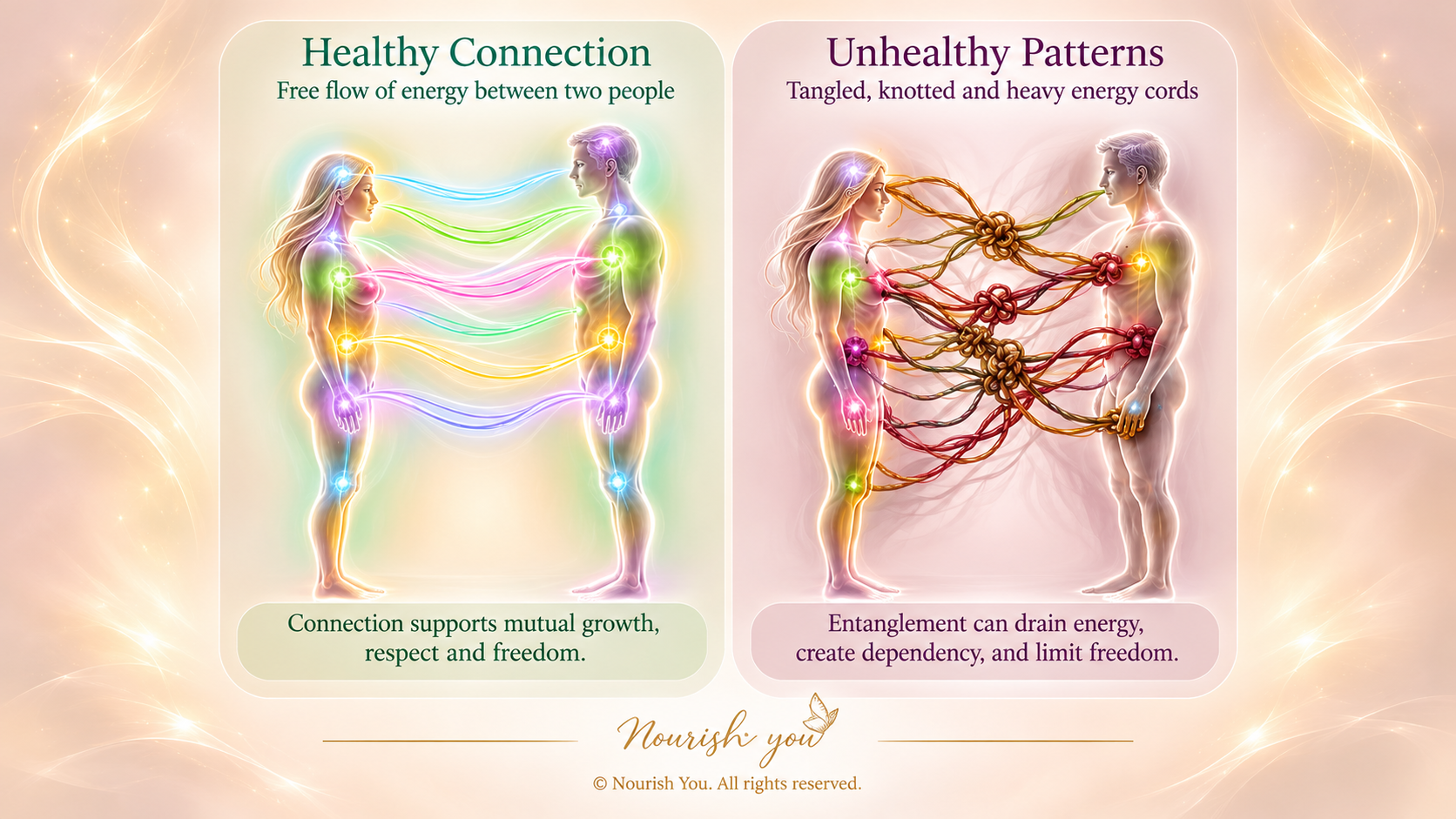
There is another dimension I find particularly meaningful in my work with clients: the energetic aspect of our relationships.
From an energetic perspective, we interact in relationships through cords of auric light that connect our energy centres, or chakras, with those of another person. These cords are believed to form between corresponding chakras — the first chakra of one person with the first of the other, the second with the second, and so on. Each connection reflects a different dimension of how two people interact, creating a complex energetic web that extends beyond what is consciously perceived. Through these living connections, feelings, attention, information, and energy flow between people. The deeper and more intimate the relationship, the stronger and more complex these cords tend to become. Barbara Brennan, one of the best-known teachers in the field of energy healing, also describes these cords as part of the way people exchange energy in relationships.
When these connections are healthy and balanced, energy flows freely while each person remains centred in themselves, with a clear sense of their own identity and personal boundaries. For empaths, however, maintaining that balance can sometimes be more challenging. Their energetic boundaries may feel more open or porous, making it difficult to distinguish their own feelings from the energies and emotions they pick up from others. In the language of the chakras, the heart is associated with love and compassion, while the solar plexus relates to personal power, self-esteem, will and boundaries. When the desire to give and care from the heart is not supported by a strong sense of self, compassion can gradually turn into over-giving.
Over time, this can lead to a form of energetic entanglement, where a person’s attention, emotional wellbeing and sense of balance become too closely tied to another person’s experience. In energetic work, these cords may appear as dense, heavy, dull or sticky. Rather than forming clear, flowing connections, they may appear tangled, knotted, or doubled over with one person’s energy field seemingly spilling into the other’s. This energetic perspective offers another way of understanding why certain relationship patterns keep repeating, even when there is a genuine desire to change. An empath may find themselves drawn back into familiar roles — taking responsibility, trying to fix things or carrying another person’s emotional weight — almost as though something keeps pulling them back into the same dynamic.
So how do we begin to change these patterns?
Conscious awareness is an important part of the process, but sometimes understanding a pattern intellectually is not enough to shift it at a deeper level. In my work, energetic clearings, including working with the cords themselves, help address the entanglements, energetic imprints and distortions that may be keeping these dynamics in place. The intention is not to remove love or sever a meaningful bond. Rather, it is to release the dense, outdated or borrowed energy that may have accumulated within the connection, while reclaiming the parts of our own energy we have unconsciously given away. As these entanglements are cleared, the cords can become brighter, more energised, flexible and resilient, supporting a healthier and more balanced exchange.
For me, the essence of this work is about restoring a healthier relationship with ourselves while remaining connected to others. It is about allowing love and compassion to coexist with energetic integrity, personal boundaries and a greater sense of inner freedom.
A soul perspective: what if this is part of our growth?
From a soul perspective, life can be understood as a journey of learning, growth, evolution and expansion. Our relationships, experiences and challenges offer opportunities to discover more of who we are, develop qualities that are not yet fully expressed and bring greater awareness to the way we live.
Before incarnating, a soul may choose particular family dynamics, ancestral lineages and relationships because these experiences offer opportunities to explore specific lessons. Soul contracts with particular individuals may form part of this pre-birth planning.
I find this perspective especially meaningful when exploring the recurring patterns in my clients’ lives, particularly those that seem difficult to change despite a genuine desire to do things differently. When working with clients in the Akashic Records, I often find that an important soul lesson for empaths is learning to care without abandoning themselves in the process. This may involve developing emotional and energetic boundaries, recognising their own needs and understanding the difference between being of service and feeling responsible for everyone else’s wellbeing.
Perhaps the deeper invitation is to discover that love does not require rescue, compassion does not mean saying yes to everything, and personal needs deserve the same care and attention they so readily give to others.
Understanding the patterns we inherit
Alongside our soul journey, there is another important influence worth exploring: the family and ancestral patterns we inherit, as they can also shape how we understand love, responsibility and our place in relationships. Beyond our individual childhood experiences, beliefs about love, sacrifice and responsibility can be passed down through generations. In some families, looking after everyone else is simply what people do. Sacrifice may be seen as proof of love, while keeping the peace is valued more highly than expressing an uncomfortable truth. Children may grow up believing their role is to be the strong one, the helpful one or the person who never causes trouble.
Over time, these expectations become so deeply embedded that they are no longer recognised as learned behaviours. They simply feel like an unquestioned part of a person’s identity. From a soul-growth perspective, recognising such an inheritance can be a powerful turning point.
A person may find themselves questioning what has always been considered normal within their family and choosing a different way of relating. In doing so, they create the possibility of change, not only for themselves but potentially for future generations. This does not mean that every difficult experience was deliberately chosen, that anyone is responsible for another person’s behaviour or that finding spiritual meaning in a relationship requires remaining in a harmful situation. It simply offers another way of exploring our experiences, alongside the practical and emotional realities of what is happening.
Instead of asking only, “Why is this happening to me?”, it might also be worth reflecting on:
- What is this relationship bringing to my awareness?
- Which familiar patterns am I repeating?
- What am I learning about love, self-worth, trust or personal power?
- What am I now ready to do differently?
There is no need to find a spiritual lesson in every situation. But when a pattern becomes overwhelming or appears repeatedly across different relationships, looking a little deeper may reveal something meaningful.
Letting go of the role that has always been played
One of the challenges in transforming these dynamics is that they can become so familiar that they feel like part of who we are. Perhaps the role is being the caring one, the strong one or the person who is always there for everyone else. Others may have grown accustomed to that role, too. Stepping back can therefore feel unfamiliar, uncomfortable or even selfish. There may be a fear that changing behaviour will be interpreted as withdrawing love. Guilt can arise when a loved one is left to manage their own difficulties. And when personal worth has long been measured by how much is given, it can take time to discover who we are beyond the role of being constantly needed.
Yet a person is more than the role they play in their relationships. Each person has interests, dreams, needs and experiences of their own. Each person has a unique soul path, with individual lessons, choices and timing. When so much attention is directed towards someone else’s life, it becomes easy to lose sight of what is waiting to unfold in our own.
There is also another important aspect to recognise: continually rescuing another person, even with the best intentions, may unintentionally limit their opportunities to discover their own strength, make their own decisions, experience the consequences of their choices and learn from them. Stepping back can therefore be an act of trust rather than abandonment. It allows another person to take greater ownership of their life, while giving the empath permission to reconnect with their personal needs, choices and path. When a pattern has been carried through a family or ancestral lineage, it is possible to honour where we come from without continuing to repeat everything we have inherited. There is no need to reject the past in order to create a different future.
In my work, I often explore the deeper patterns, emotional imprints and energetic restrictions that may contribute to the challenges people experience today. Sometimes, becoming aware of a pattern is the beginning of a shift. A person starts to understand why a situation feels so familiar, why a particular reaction keeps arising or why similar circumstances seem to repeat themselves. But awareness is only part of the process. The shift also needs to take shape in everyday life, through new choices and responses.
That may mean practising saying no, allowing someone to feel disappointed, resisting the urge to intervene or learning to sit with uncertainty without feeling compelled to resolve it. These small but meaningful changes can gradually loosen the hold of an old role and create space for healthier, more balanced relationships.
Finding a healthier balance
If you recognise yourself in some of these patterns, there is no need to criticise yourself for the ways you have tried to help, protect or care for others. Your responses may have developed for understandable reasons, and your sensitivity is not something you need to lose.
The invitation is to become more conscious of what happens when someone you love is struggling. The next time you feel compelled to fix a situation, perhaps pause and ask yourself:
- What am I feeling right now? Am I responding to their needs, or trying to ease my own worry, guilt or discomfort?
- What is genuinely mine to take responsibility for, and what belongs to the other person?
- Have they asked for my help? Would listening be more supportive than offering advice or a solution?
- What do I need in this moment, and how can I honour that while still caring about them?
There is no need to answer these questions perfectly. Sometimes the simple act of pausing is enough to interrupt an automatic response and make room for a more conscious choice.
Remember, too, that boundaries are not walls that keep love out. They allow us to remain connected to others while respecting both their freedom and our own wellbeing.
Ready to explore your relationship patterns?
Discover how soul-level work can help you gain clarity, release energetic entanglements and move towards healthier, more balanced relationships.
Not sure where to begin? You’re welcome to get in touch if you have any questions.